
• Skip to primary navigation
  • Skip to main content
  • Skip to primary sidebar
  • Staff
  • About Us
  • Contact Us

Myers Park Hoofprint

The Myers Park High School Newspaper

  • Arts & Entertainment
  • Campus News
  • Editorials
  • Features
  • Local/National
  • Sports
  • World News
  • Editor’s Notes
  • Podcasts

Emma Monroe

New Year’s Resolutions 

February 12, 2025 By Emma Monroe

Photo contribution by Greenvans

Before I begin this article, I’ll tell the story of how it was pitched. It was the Myers Park Hoofprint Christmas Party, and we had just finished our annual White Elephant. One of our editors suggested that we all go around and say our New Year’s resolutions. Everyone said very admirable resolutions, except myself, because I could not come up with anything to say. It felt like I should have a resolution, because of the season, but a resolution did not come naturally to me. Resolutions aren’t confined to a certain time of  year, and yet, the pressure of changing oneself for the New Year is omnipresent. 

I pitched this article to advocate against the “New Year, New Me” messaging. Most holidays are guilty of propagating messages they claim only apply to their time of year– Thanksgiving as the only time to be thankful, Christmas as the only time to give. While the point of these holidays wasn’t necessarily to confine these principles of gratitude, empathy, and change to a specific time of year, they have morphed into selective dates where people feel obligated to meet the societal expectations about the holiday, but rid themselves of those obligations otherwise. 

This unfortunate phenomenon is especially applicable to New Year’s Resolutions. We all know the statistics. Gym memberships spike in January only to wane in February. Diet plans go well for twenty days only to fall off the second the New Year’s optimism ends. New Year’s resolutions are often inorganic, with ninety-five percent of people who make New Year’s resolutions failing to achieve the goal they set. Instead of coming to resolutions naturally, people wait till the New Year’s to change themselves and do not find success because of the lack of authenticity of their resolutions. Why should they try to lose weight when they are motivated in May if all their peers are doing so in January? 

In addition, New Year’s Resolutions often foster a culture of consumerism. When examining the statement’s denotation, New Year’s Resolutions are simply goals, but its connotation tells a different story– a story of environmental degradation. Big corporations, particularly in the beauty industry, will weaponize the “New Year, New Me” messaging to convince consumers that the messaging truly means “New Year, New Clothes.” Brands like H & M and Shein sell the most amount of clothes during the holidays, including New Year’s. Makeup brands convince consumers that they need their product to glow up– food companies that they need their product to eat healthier. This excess consumerism has an immense environmental impact, perpetuating climate change through the carbon dioxide emissions required to manufacture these unnecessary products. 

It is important to note that I am not arguing that no positive resolutions are made at New Year’s. In fact, I ended up making a resolution at New Year’s, to quit drinking Diet Coke. However, this resolution was not due to the time of year, as I was not planning it in advance. It was instead due to the fact that when I traveled to Costa Rica over Christmas break, they did not sell Diet Coke, so I was forced to go cold turkey off of the drink for nine days. When I came back, I no longer felt the desire to drink Diet Coke, so I quit for the health benefits. It wasn’t a New Year’s Resolution, it was just a resolution that happened to occur around New Years. Resolutions around New Years are not the problem, the culture of New Year’s resolutions that pressures people to inorganically better themselves by buying a product is. 

Gratitude should not be confined to a time of year. Giving should not be confined to a time of year. Resolutions should not be confined to a time of year. I am of the firm belief that people should change their lives when they are inspired to do so, prioritizing longevity and authenticity in resolutions over fitting in with the “New Year’s resolutions” trend. 

Filed Under: Pro and Con

On Taoism

February 12, 2025 By Emma Monroe

My first introduction to Taoism was a cheap, watered-down version of the religion, known as Dudeism. A couple students in my philosophy class junior year chose to present Dudeism for their religion project, explaining how the core principles of the religion were going with the flow, chilling out, and enjoying life as it comes. I thought it was complete nonsense. How could I ever accomplish anything if my philosophy was to simply let things happen? 

With my skeptical mindset, you can imagine that when we learned about Taoism a couple weeks later in class, I did not think highly of the religion. Taoism, as I understand it, is an ancient Chinese religion and philosophy that preaches ideals such as inaction, simplicity, and harmony– more sophisticated ways of “going with the flow.” We read excerpts from the Tao Te Ching, the primary religious text of Taoism, translated into English. The Tao Te Ching isn’t exactly known for its clarity, but it is fairly blunt in expressing what the author, Lao Tzu, deemed as universal truths. For example, the Tao Te Ching includes statements like “If nothing is done, then all will be well” and “the more you know, the less you understand.” 

In modern western society, the majority of people disagree with these statements. Inaction is the antithesis of capitalism, where hard work is upheld as a virtue. Learning is encouraged, school systems teaching students that knowledge is power. While people joke about going wherever the wind takes them, the only people who truly reject these western virtues are active nihilists, who believe nothing matters. 

In my case, I did not pretend to find the laid-back, taoist lifestyle appealing, but rather, expressed my distaste for the religion at every chance I could in class. It got to the point where whenever my teacher brought up Taoism, he would jokingly refer to it as “Emma’s favorite religion.” I could not have been more anti-Tao. 

However, my perspective on Taoism was permanently altered on a plane flight I took in November of 2024, where I decided to read the first chapter of “Star Wars: The Philosophy Strikes Back.” The book was a collection of essays relating the Star Wars movies to varying philosophical concepts, beginning with The Phantom Menace. Unpopularly, The Phantom Menace has always been one of my favorite Star Wars films– it has pod racing, Qui-Gon Jinn, and a “duel of fates”– what’s not to like? I was excited to read the chapter on The Phantom Menace, even if it was about Taoism’s influence on the movie. 

Upon reading the chapter, I was introduced to a whole new way of thinking about Taoism. The author Russel P. Johnson presented two concepts in Taoism that I resonated with: Symbiosis and concentrating on the moment. Symbiosis is essentially the idea that all things in nature are interconnected, and thus rely on each other. Symbiosis is encompassed in the Yin-Yang symbol, which represents how two opposites cannot exist without each other. Concentrating on the moment is simply not worrying about the consequences of the future, and instead prioritizing solving the issues of the present. I was surprised that I agreed with any statements in the Tao Te Ching, leading me to question my initial perception of the religion. 

I had misunderstood Taoism. It is not nonsense advocating for complete inaction; it is a valuable interpretation of how to effectively handle the ups and downs of life. While refusing to learn and doing nothing are far too extreme applications of the religion, having a taoist mindset can have a significant impact on everyday life. Instead of committing myself to one political ideology, I have found value in the opposing party. Instead of writing all of my assignments down in my planner and worrying about them two months in advance, I have focused on my present assignments. Although these might be small changes, they have increased my empathy level and reduced my stress. Despite my initial skepticism, I can honestly say that Taoism has positively impacted my life, and is beneficial in counteracting the pressures of modern day society. 

Filed Under: Editorials

Teacher of The Paper : Ms. Blackert

February 12, 2025 By Emma Monroe

For the month of February, the Myers Park Hoofprint has chosen math teacher Ms. Blackert to highlight as the Teacher of the Paper. Ms. Blackert grew up here in Charlotte, North Carolina, graduating from Olympic High School and obtaining her college degree at the University of North Carolina Wilmington. She has been teaching for twenty-seven years for the Charlotte Mecklenburg School system, nineteen of those spent at Myers Park thus far. She teaches Math 3 and IB Analysis & Approaches SL 2, and gave the Myers Park Hoofprint a little bit of information about the classes and herself. 

  1. What material does your class(es) consist of? 

Ms. Blackert’s classes are essential for most students at Myers Park, as Math 3 is a requirement to graduate, and IB Analysis & Approaches SL 2 is one of the math courses senior IB students can take to fulfill their math credit. However, they are both still stimulating classes for students to improve their mathematical abilities. Ms. Blackert explained that in IB Analysis & Approaches SL 2, the students learn about “logarithms and exponentials, some calculus things related to those functions, a lot of trigonometry, and a little bit of statistics.” In Math 3, students learn about “Piecewise and linear functions, quadratics, a little bit of logarithms and exponentials, a little bit of statistics, and a little bit of rational functions, but nothing to the degree that we do in Sl 2.” 

  1. Why should students sign up for your class? 

While Math 3 is non-negotiable, Ms. Blackert explained the appeal of IB Analysis & Approaches SL 2 for students deciding which IB math to take, calling it a “good middle of the road math.” “It’s not the hardest, but it’s also not the easiest, and it has more applications to what people may want to do in college.” 

  1. What is your favorite part about teaching at Myers Park? 

“The math department, they are just all-around very supportive in every way that a teacher needs to be supported,” Ms. Blackert said, extendeding that support to the administration as well. She also loves bonding with the students at Myers Park, stating that she “really enjoys the diversity of the students” across all levels of math. 

  1. If you could have dinner with one person, dead or alive, who would you have dinner with? 

Ms. Blackert provided two answers for this question. Her immediate answer was David Hudspeth, a former Myers Park teacher who died about two years ago. Ms. Blackert expressed her fondness for the teacher, stating that she “really misses him.” Her second answer was Martin Luther King Jr, who she says would be “really cool” to sit down with. 

You can visit Ms. Blackert in room SC20 to learn more! 

Filed Under: Columns

AP vs. IB

May 29, 2024 By Emma Monroe

While registering for classes, you might have noticed strange letters beside some of the course options. Specifically, the letters AP and IB. While these letters might not seem terribly significant, they signal the type of class you are able to register for, typically implying an increased difficulty from the class’s honors counterparts. AP is short for Advanced Placement and IB is short for International Baccalaureate. But regardless of the nomenclature, there are clear advantages and disadvantages of both programs that you ought to consider before signing up for either. 

There are a few similarities between the two programs. Naturally, the workload is heavier than an honors class. The classes operate on a 5.0 rather than a 4.0 scale, and the classwork is reflective of this bump. “The rigor of AP is relatively the same as IB,” notes senior AP participant Emerson Cortazar. However, it must also be noted that less 5.0 classes are required in the AP Capstone Program. With IB, you must take at least 13 over the course of your junior and senior years, but with AP, it is only 6. This makes AP more accessible to those who don’t wish to fully immerse themselves in difficult environments. On the other hand, the lack of immersion can sacrifice a tight knit community. “AP lacks the closeness of the IB community,” Emerson observes, and junior IB participant Rachel Kreth clarifies this, stating, “In IB, everyone around you is, for the most part, doing all of the same things. That’s useful when you need help to know you’re all going through the same thing.” 

Another similarity between the programs is the resume building. AP junior Madison Grant claims that she signed up for AP “because it looks good for college applications.” Colleges seek out rigorous courses when evaluating your resume, which AP and IB definitely fulfill. Taking those 5.0 boosts your GPA, which can in turn boost your class rank, all factors that colleges look at when deciding to admit or reject an applicant. Fellow AP junior Bennett Hall furthers this, describing AP Capstone as something “that will help you stand out on college applications by showcasing your commitment to academics and research.” Yet, this advantage comes with a price. “I dislike the constant testing and quizzing in IB,” Rachel explains. “When every day has something, it feels very performative.” 

A major downside of both programs is the lack of diversity. Madison notes that she is “the only Black person in the class” majority of the time when it comes to her AP class, and several other IB students notice the problem as well. The demographics of the AP and IB programs do not reflect the demographics of Myers Park. Oftentimes, the lack of diversity can defer students away from the program who would normally participate in the higher level classes. The programs appear inaccessible, despite the fact that many students would thrive in AP or IB. 

AP and IB both require end of year tests to receive their respective diplomas. These tests differ from traditional finals in the sense that they are off campus and will not affect your final grade. However, these tests could impact your college lifestyle, as passing an AP or IB exam can earn you credits that exempt you from entry level college courses. This provides many students with a motivation to do well on these exams. IB student Evie Freeman notes the exams academic benefits, but also notes the personal. “I really appreciate we get the full day off of school for the exams,” she says, a component not present in a regular final. Junior IB participant William McEvoy claims “the fancy paper we write on” to be the coolest part of the exams, and Evie adds onto this, stating that “the string tag is awesome.” 

For the most part, AP and IB are fairly similar programs. They have clear advantages, such as building college applications, developing communities, and having really cool testing papers, but also clear disadvantages, such as a lack of diversity and rigorous courses. “The heavy workload connected with AP courses can be difficult for certain students,” Bennett expresses. But, none of the students mentioned previously regret enrolling in AP or IB. They might be difficult programs, but they can also be rewarding ones. 

Filed Under: Editorials

Reneé W(Rapp)ed

March 28, 2024 By Emma Monroe

Reneé Mary Jane Rapp is a name widely known by a variety of individuals: theater kids, original Mean Girls fans, pop/rock enthusiasts, or people with the simple yet chronic condition of addiction to Tik Tok. She rose to popularity with her role of Regina George on the broadway adaptation of early 2000s chick flick Mean Girls, playing the part from June of 2019 to March of 2020, when production shut down due to the COVID-19 pandemic. Rapp furthered her acting career by securing the role of Leighton Murray on a teen comedy series titled The Sex Lives of College Girls, and her singing one by visiting Los Angeles, Manhattan, Boston, and Atlanta on her first tour “Everything to Everyone: The First Shows and releasing her debut album, Snow Angel, in August of 2023. What many recognize her from is her most recent project, a Mean Girls reprise, which came out in theaters just a couple months ago, in January of 2024. Although it received mixed reviews, it is indisputable that the movie painted Rapp in a positive light for the general public. 

However, while most could list these facts about the actress/singer when prompted, many could not speak on her background. She did not simply emerge from a void of nepotism, she worked from the bottom up, making an honest living before stepping into the view of Hollywood’s eyes. Unlike most celebrities, who are derived from the glitz and glam of New York City or Southern California, Rapp comes from a region familiar to the majority of Hoofprint Readers: Huntersville, North Carolina, a well known suburb of Charlotte. Rapp attended North West School of The Arts, an arts school in the heart of Charlotte.

Rapp was born on January 10, 2000, approximately forty minutes away from Myers Park High School. She attended Hopewell High School for a couple years, before transferring to Northwest School of the Arts, abandoning her role of the varsity women’s golf team to fully pursue her passion for theater. Her theater teacher during her time at the school, Corey Mitchell, explained that Rapp “has a special distinction…There is a difference when that vocal ability is coupled with sincere emotions that can move an audience and that literally can excite an audience.” During her senior year of high school, she notably won Best Actress at Charlotte’s Blumey Awards for her performance as Sandra in the Northwest production of Big Fish. This win led her to receiving the nomination for Best Performance by an Actress at the Jimmy Awards In New York City, which she ultimately won as well. She stayed in Charlotte for a period of time after graduating, acting as Wendla in Theater Charlotte’s production of Spring Awakening. She was nominated for Best Actress in a Musical (local) at the 2018 BroadwayWorld Charlotte Awards as a result of this role. 

Denise and Charlies, Rapp’s parents, still reside in Huntersville, having moved to the town back in 1995 due to a job opportunity for Denise, who is a certified public accountant. That’s to say, although Rapp has moved on to bigger and better pursuits that Charlotte could not fully fulfill, she still has a connection to the Queen City. Rapp has only been in the spotlight for a couple of years, and still has ample time to establish herself as “one of the greats.” It can only be hoped that her fame won’t blind her too much, so that she will seldom forget about her roots, at Northwest and in Charlotte as a whole. It would be a shame to forget the beauty this city has to offer, even if such isn’t always obvious or acknowledged. Nevertheless, it will be exciting to see where her career takes her next.

Filed Under: Arts & Entertainment, Local/National

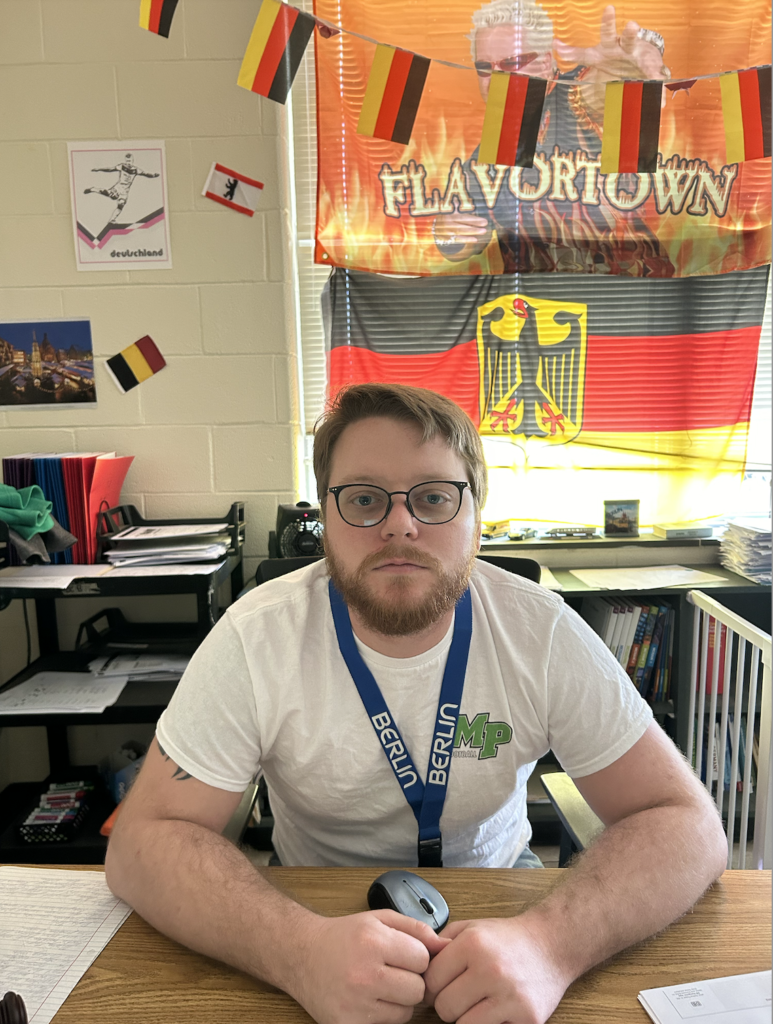
Teacher of The Paper: Herr Elkins

March 28, 2024 By Emma Monroe

Photo contributed by Emma Monroe

For the month of April, the Myers Park Hoofprint has chosen German teacher Herr (Mr.) Elkins to highlight as the Teacher of the Month. Herr Elkins grew up in Atlanta, Georgia, going on to attend the University of Georgia in Athens. He has been teaching for approximately seven years, four of which were at Myers Park. He is currently the only German teacher at Myers Park, the backbone of the German language program. The program offers a variety of levels, ranging from German 1 to IB Language B: German HL 2. Herr Elkins wishes more students would partake in the German program and has answered a few questions regarding the class and himself. 

  1. What material does your class(es) consist of? 

In German class, they focus on “reading, writing, speaking, and listening, trying to do something for at least one of those skills every day.” Herr Elkins says. Students accomplish this by learning German vocabulary, grammar tenses, listening to native speakers, and watching Fotoroman, a German soap opera. 

  1. Who is eligible to sign up for your class? 

“Everyone!” Herr Elkins confirmed, adding that German is a fantastic way to fulfill the two language credits every student needs in order to graduate. Even if you are already taking another language, German is still an option. “You don’t wanna be basic and do Spanish,” he jokes. 

  1. Why should students sign up for your class? 

“My class tends to be a very fun, kind of relaxed place where you can be yourself.” Herr Elkins explains. He goes on to say that he never gives any homework, so the workload won’t be too difficult, and that learning a language has a lot of mental health benefits. “It can expand your way of thinking and help you become a critical thinker.” 

  1. What is your favorite part about teaching at Myers Park? 

The students, Herr Elkins says, are what make the teaching experience worthwhile. “In basically all the classes that I have my students work really hard, they try really hard to learn German, they make the day fun even though they’re really goofy and dumb sometimes,” he says, noting that a long day goes by a lot faster because of them.

  1. If you could have dinner with one person, dead or alive, who would you have dinner with? 

He starts by saying, “It would definitely not be Thomas,” but goes on to say Herr Kurtz, his German 2001 professor. “He was one of the biggest inspirations for me as far as learning German went, and then especially as being a teacher, he was very fun and lively in class but obviously very passionate about German” he answered. 

You can visit Herr Elkins in room SC6 to learn more!

Filed Under: Columns

Primary Sidebar

Categories

  • Arts & Entertainment
  • Campus News
  • Columns
  • Editor's Notes
  • Editorials
  • Education
  • Features
  • Local/National
  • Podcasts
  • Pro and Con
  • Seasonal
  • Sports
  • World News

Newspaper 2023-2024

Newspaper Application

Archives

Copyright © 2026 Myers Park Hoofprint